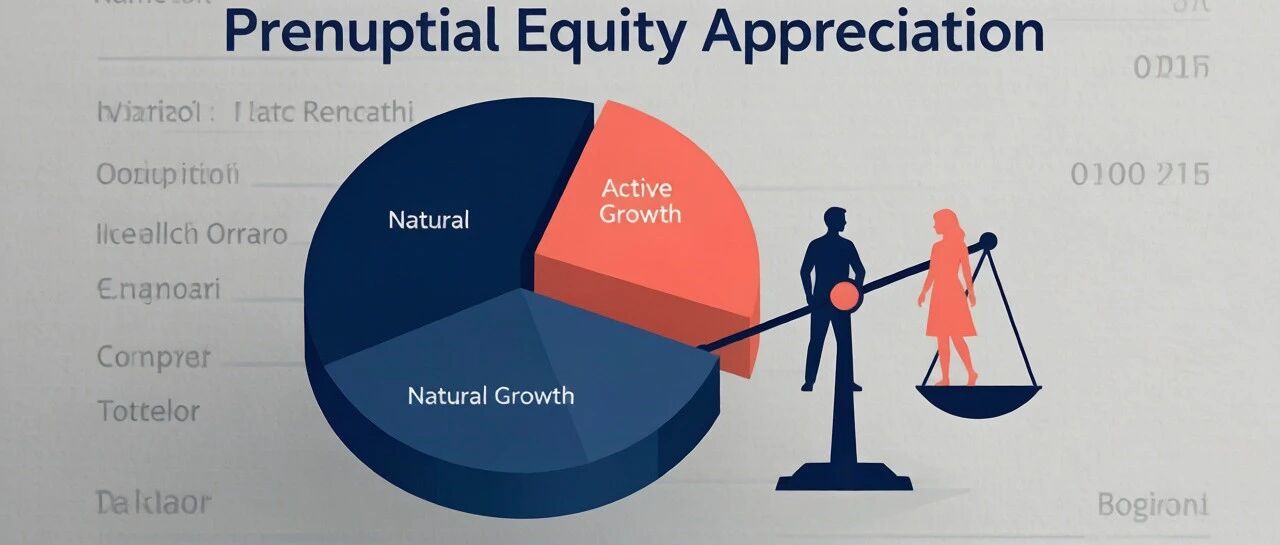
This article centers on the high-frequency dispute of “how to divide the post-marriage appreciation of premarital equity at divorce,” and, combining the theory of the matrimonial property regime under the PRC Civil Code, the principle of separating shareholder status from property interests under the Company Law, and judicial adjudication rules, provides an actionable framework for analysis.
Core Conclusion (answered upfront): The company equity held by one spouse before marriage belongs, as such, to that spouse’s separate premarital property and is not divided upon divorce; however, whether the post-marriage appreciation of the equity constitutes marital property hinges on the nature of the appreciation — “natural appreciation” arising from market conditions and passive holding belongs to the individual; “active appreciation” (i.e., investment income) arising from one spouse’s post-marriage labor and operation or management belongs to the marital property, and the other spouse is entitled to a share upon divorce. The legal basis is Article 1062 of the PRC Civil Code (investment income belongs to marital property) and Article 1063 (premarital property belongs to separate property).
I. A Real Scenario That Breaks Entrepreneurs
In 2018, “Old Wang” founded a technology company on his own, holding 60% of the equity, with annual revenue of RMB 5 million. He married in 2020, and after marriage he continued to serve full-time as CEO and manage the company. Over five years, the company’s revenue grew to RMB 50 million and its valuation multiplied several-fold. In 2025, as the marriage broke down and divorce loomed, his wife asserted: “The equity is yours from before marriage, I won’t contest it; but this ten-fold appreciation was forged by both of us after marriage, and I want half of the appreciation.” Old Wang was stunned: “It’s premarital — what does it have to do with you?”
How does the court actually rule? The answer lies not in the emotion of “should it be divided,” but in a cold legal concept: is this ten-fold appreciation “natural appreciation” or “active appreciation”?
II. Legal Characterization: Which Category of Property Does the Post-Marriage Appreciation of Premarital Equity Belong To?
The first step in dividing marital property is to characterize the property. Under the PRC Civil Code:
| Type of Property | Ownership | Legal Basis |
|---|---|---|
| The premarital equity itself | Separate property | Article 1063(1) of the PRC Civil Code — “a party’s premarital property” |
| The “natural appreciation” of the equity after marriage | Separate property | Doctrinally classified as fruits / natural appreciation of separate property |
| The “investment income” (active appreciation) of the equity after marriage | Marital property | Article 1062(2) of the PRC Civil Code — “income from production, operation, and investment” |
Note that the wording of Article 1062 is “income from investment,” not “the subject of investment.” In other words, the equity itself (the subject of investment) belongs to the individual, but the income generated from the investment belongs to the marital estate — this is precisely the legal fulcrum for distinguishing “natural appreciation” from “active appreciation.”
III. Legal Rationale: Why Distinguish Two Kinds of “Appreciation”?
The legal rationale of the marital community property system (the post-marriage-acquired community system) is the “theory of joint effort”: during the marriage, the spouses render mutual assistance in life, economy, and emotion, and the property obtained by one spouse crystallizes the other’s contribution (housework, emotional support, indirect economic outlay); therefore, post-marriage acquisitions are presumptively joint.
But the theory of joint effort has its limits — only property growth that crystallizes the spouses’ joint effort (especially human input) is brought into the marital property. If the property’s appreciation stems entirely from external market factors and has nothing to do with either spouse’s effort, it should not be brought into the marital property, or it would offend fairness.
Thus, the Supreme People’s Court has, in judicial practice, developed the distinction between “natural appreciation” and “active appreciation”:
- Natural appreciation: property passively appreciates due to external factors such as a rising market, inflation, or policy dividends, unrelated to the owner’s labor input. Typical examples include a premarital home appreciating because of a general rise in housing prices, or premarital equity passively rising due to an industry windfall. Such appreciation belongs to the individual.
- Active appreciation: property appreciates because the owner devotes time, energy, operation, management, or labor. Typical examples include one spouse driving performance growth by running the company full-time after marriage, or one spouse renovating and leasing an investment property after marriage to obtain rental income. Such appreciation is characterized as “investment income” and belongs to the marital property.
This distinction is reflected in the adjudication views of the Civil Division of the Supreme People’s Court and the adjudication guidance of several high people’s courts, and has become the mainstream adjudication approach for handling the post-marriage appreciation of premarital property.
IV. Judicial Adjudication Rules: How the Court Determines the “Degree of Participation in Management”
After characterization, the hardest part is fact-finding — how much of the appreciation comes from market dividends and how much from personal management? Common adjudication scenarios in practice:
Scenario 1: One spouse runs the business full-time after marriage (CEO / chairman / actual controller) The company’s performance is strongly correlated with the spouse’s operation and management, so the appreciation is more likely to be characterized as “investment income” (marital property). The court typically brings the entire appreciation into the division of marital property, but will weigh factors such as the duration of the marriage, the managerial contribution, and whether there were other joint contributions in determining the ratio.
Scenario 2: One spouse is completely uninvolved in management after marriage, holding only as a nominee The company’s appreciation mainly comes from market dividends or others’ management, and the appreciation tends to be characterized as “natural appreciation” (separate property). Even if the holder is a shareholder, so long as they did not actually participate in operation and management, the appreciation belongs to the individual.
Scenario 3: One spouse participates partially (e.g., serves as a director, participates in decisions periodically but not full-time) The court handles it by discretion according to the “degree of participation,” and may divide the appreciation into a “natural appreciation portion” and an “active appreciation portion” for separate characterization. A few cases introduce audit or appraisal to try to quantify the respective contributions of market factors and managerial factors, but such fine-grained calculation is costly and hard to admit in judicial practice; most cases still proceed by a “one-size-fits-all” approach or negotiation.
Key adjudication tip: The party asserting that the appreciation is marital property (usually the spouse) bears the initial burden of proof — they must show that the equity holder actually participated in the company’s operation and management after marriage. If the holder claims the appreciation is natural appreciation, they may produce evidence that the company’s growth mainly came from an industry-wide upturn, third-party team management, etc.
V. From the Perspective of the Company Law: Even If the Appreciation Is Divided, What Is Divided Is “Money,” Not “Shareholder Status”
What worries many entrepreneurs most is: after the appreciation is characterized as marital property, will the spouse directly become a shareholder and dilute control?
The answer is no. Here we must distinguish two levels:
1. The shareholder-status level (rights of identity) Shareholder status is determined by the industrial and commercial registration, and carries communal rights such as voting rights, inspection rights, and proposal rights. The spouse is not a registered shareholder and does not acquire shareholder status directly upon divorce. Even if the property interest belongs to the spouse, this does not automatically confer shareholder status — this touches on the company’s nature as a close corporation.
2. The property-interest level (rights of self-interest) The property value corresponding to the equity (dividends, appreciation, distribution of residual assets), having been formed by investment with marital property or constituting investment income, is jointly owned by the spouses. What is divided at divorce is the equity’s “property value,” typically handled by way of offset compensation — the holding spouse continues to hold the equity and pays the corresponding compensation to the other party.
The newly revised Company Law (effective July 1, 2024), Article 88, further clarifies the capital-contribution liability in equity transfers: after a transfer of un-paid-in equity, the transferee bears the payment obligation; if the transferee fails to pay on time, the transferor bears a supplementary liability. This means that when dividing un-paid-in equity at divorce, the offset calculation should deduct the contribution obligation for the un-paid-in portion, otherwise “getting half the equity” may equal “getting half the debt.”
In one sentence: What divorce divides is the equity’s “money,” not the shareholder’s “seat.” Whether control is shaken depends on the articles-of-association design and equity structure, not the divorce itself.
VI. Reference to the Partnership Enterprise Law: How Does the Division of Partnership Interests Differ?
If what is held before marriage is not company equity but a partnership enterprise (especially a limited partnership LP interest), the division logic is both similar and different:
- Limited partner (LP) interest: The LP does not execute partnership affairs, and the appreciation of its interest is closer to “passive investment income.” If the LP did not participate in partnership operation after marriage, the appreciation tends to be characterized as natural appreciation (separate property); but if the LP makes additional investments after marriage or substantively participates in decision-making, it may be characterized as investment income.
- General partner (GP) interest: The GP executes partnership affairs, with evident managerial input, so the appreciation is more likely to be characterized as investment income (marital property). Moreover, Article 22 of the Partnership Enterprise Law provides that a partner’s transfer of property interests to a person other than a partner requires the unanimous consent of the other partners (unless the partnership agreement provides otherwise), which contrasts with the rule of “other shareholders’ right of first refusal” in the division of company equity.
For entrepreneurs who hold company equity through a limited-partnership holding platform (such as an employee stock ownership platform), the above distinction is especially important — the “passive nature” of the LP interest may become a favorable factor in asserting natural appreciation.
VII. Practical Recommendations for Entrepreneurs: Rather Than Gamble on the Court, Arrange in Advance
1. Premarital / marital property agreement (certainty first) Article 1065 of the PRC Civil Code permits spouses to agree on the ownership of premarital and post-marriage property. It is advisable to sign a written agreement before or during marriage, expressly agreeing that “the premarital equity and its post-marriage appreciation shall belong to one party,” turning uncertainty into certainty. Note: the agreement must be signed voluntarily and may not be conditioned on divorce (an agreement conditioned on divorce is a divorce agreement, effective only upon registered divorce); it may not harm the interests of creditors (it cannot defeat a bona fide third party).
2. Keep records of capital contributions to avoid commingling When making additional investments after marriage using a premarital personal account, be sure to retain complete bank records and note the purpose, to avoid commingling with marital property. Account commingling is a common reason why “separate property” gets characterized as “marital property.”
3. Evidence management of the degree of management participation If you wish to assert that the appreciation is natural appreciation, preserve evidence of “non-participation in management” (e.g., not holding a position in the company, no salary records, agreements entrusting a professional manager to manage). Conversely, if the spouse asserts marital property, evidence of the other party’s participation in management should be preserved.
4. Control protection at the articles-of-association level Pre-set equity-stability clauses in the articles of association (such as restrictions on equity repurchase / transfer at divorce, and other shareholders’ right-of-first-refusal clauses), so that even if the property interest is divided, control is not shaken.
VIII. Frequently Asked Questions (FAQ)
Q1: For premarital equity that appreciates after marriage, is the spouse necessarily entitled to a share? Not necessarily. It hinges on the nature of the appreciation. If it is natural appreciation (passive market factors), it belongs to the individual and the spouse has no right to a share; if it is active appreciation (arising from one spouse’s post-marriage managerial input), it is investment income and marital property, and the spouse is entitled to a share. The burden of proof lies with the asserting party.
Q2: How to distinguish natural appreciation from active appreciation? Is there an explicit legal rule? Articles 1062 and 1063 of the PRC Civil Code distinguish the scope of marital property from separate property: “investment income” is marital and “premarital property” is separate. The “natural vs. active appreciation” distinction is a refined interpretation of the “investment income” concept developed in judicial practice, originating from the adjudication views of the Civil Division of the Supreme People’s Court and local adjudication practice; it is not an independent statutory provision.
Q3: Can the spouse directly become a company shareholder upon divorce? Generally no. The spouse receives the property value of the equity (offset compensation), not shareholder status. Only if both parties agree and the other shareholders consent (waiving the right of first refusal) may the registration be changed to make the spouse a shareholder.
Q4: If the premarital equity has not been fully paid in, how is it divided at divorce? The un-paid-in portion should be deducted from the appraised value, because the party receiving the equity must continue to bear the contribution obligation (Article 88 of the newly revised Company Law). The offset is calculated on the value corresponding to the “paid-in portion,” to avoid “getting equity equal to getting debt.”
Q5: For a premarital LP interest in a limited partnership, who gets the post-marriage appreciation? The LP does not execute partnership affairs; if it did not substantively participate in management after marriage, the appreciation tends to be characterized as natural appreciation (separate property). But if additional investments are made after marriage or it substantively participates in decision-making, it may convert to investment income (marital property). Because the GP interest executes partnership affairs, it is more likely to be characterized as investment income.






Leave a Reply