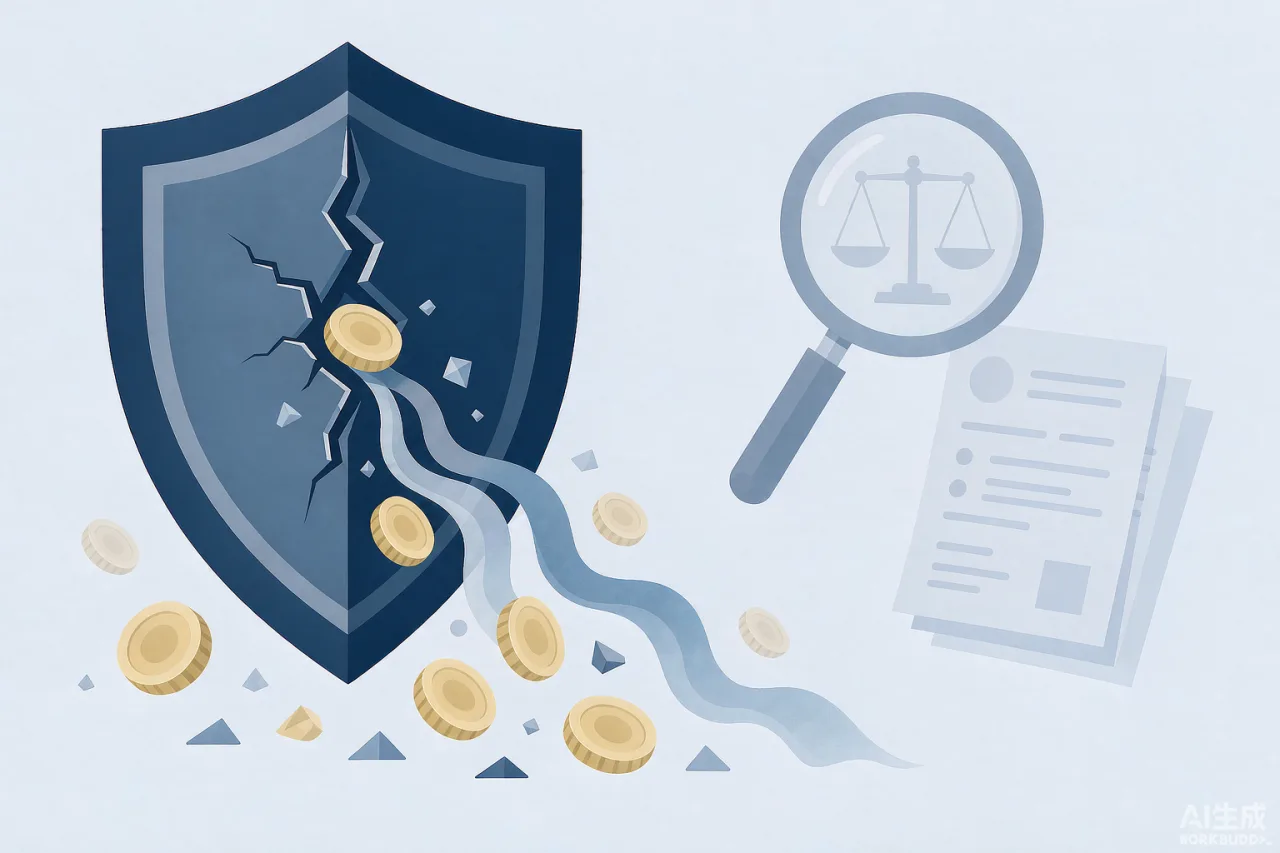
When Shareholders Strip Out Capital: Who Pays the Company’s Debts? The Test for Capital Withdrawal and Legal Liability
After the company is incorporated, shareholders take back, under various pretexts, the capital they have already paid in — borrowing it out without repaying, transferring it out through fictitious transactions, or distributing dividends on inflated profits. Once the company’s operations deteriorate and it owes external debts, and creditors come knocking, these shareholders who siphoned off funds may be required to “spit out” the capital and bear liability for damages.
This article explains: what conduct constitutes capital withdrawal? What legal liabilities does capital withdrawal incur? And what important changes has the new Company Law (2024) brought?
I. What Is Capital Withdrawal? How to Distinguish It from “Loans” and “Dividends”
Capital withdrawal refers to the act, after the company is incorporated, of a shareholder withdrawing or transferring out, without going through statutory procedures, capital already paid in, thereby harming the company’s capital adequacy.
It is fundamentally different from a normal shareholder loan or profit distribution:
| Circumstance | Does It Constitute Capital Withdrawal? |
|---|---|
| A shareholder borrows from the company, signing a loan contract, agreeing on interest, and going through internal resolution procedures | Generally not capital withdrawal; handled as a loan relationship |
| No contract, no resolution, long-term non-repayment, amount comparable to the capital contribution | Highly suspected capital withdrawal |
| The company has genuine profits and distributes them by shareholders’ resolution | Lawful dividend distribution, not capital withdrawal |
| “Dividends” distributed after inflating profits and preparing false financial statements | Constitutes capital withdrawal |
The key test is: whether statutory procedures were followed, and whether it was based on a genuine transaction or profit basis.
II. Which Acts Are Recognized as Capital Withdrawal
Article 12 of the Provisions of the Supreme People’s Court on Several Issues Concerning the Application of the Company Law (III) enumerates four circumstances in which the court shall support a finding of capital withdrawal:
- Preparing false financial and accounting statements to inflate profits for distribution — distributing “dividends” with no genuine profits is, in essence, withdrawing capital.
- Transferring out capital by fabricating a creditor’s-rights-and-debt relationship — for example, a shareholder forges evidence that the company owes them a debt and “repays” the capital to themselves.
- Transferring out capital by exploiting a related-party transaction — transferring funds out through an affiliated company by means such as high-price procurement or low-price sales.
- Other acts of withdrawing capital without going through statutory procedures — a catch-all clause, which in practice includes a shareholder transferring out a large sum shortly after capital verification without being able to explain a legitimate purpose.
In addition, in practice courts also consider the following factors comprehensively: whether the transfer-out time was immediately after the capital contribution was made, whether statutory procedures such as capital reduction or dividend distribution were followed, the ultimate flow of the funds, and whether the shareholder can reasonably explain the purpose of the transfer-out.
III. Legal Liability for Capital Withdrawal: Return of Capital + Damages + Joint Liability of Directors, Supervisors, and Senior Management
Article 53 of the Company Law (revised in 2023, effective July 1, 2024) explicitly provides:
After the company is incorporated, shareholders may not withdraw capital. Where the preceding paragraph is violated, the shareholder shall return the withdrawn capital; if losses are caused to the company, the directors, supervisors, and senior management personnel who are responsible shall bear joint and several liability for compensation with that shareholder.
Specifically, a shareholder who withdraws capital shall bear:
- Return the principal and interest of the withdrawn capital to the company;
- Where losses are caused to the company, compensate the company for its losses;
- The responsible directors, supervisors, and senior management personnel bear joint and several liability for compensation together with the withdrawing shareholder — an important addition under the new Company Law that presses the duty of supervision onto the directors, supervisors, and senior management.
IV. From the Creditor’s Perspective: The Supplementary Compensation Liability of the Withdrawing Shareholder for the Company’s Debts
Where a company creditor encounters the company’s inability to repay a due debt and discovers that a shareholder has withdrawn capital, it may, on the basis of Article 14 of Judicial Interpretation III of the Company Law:
- request the withdrawing shareholder to bear supplementary compensation liability for the portion of the company’s debt that cannot be repaid, within the scope of the principal and interest of the withdrawn capital;
- request other shareholders, directors, senior management personnel, and the actual controlling party who assisted in the capital withdrawal to bear joint liability;
- where the withdrawing shareholder has already borne the above liability, and another creditor makes the same request, the court shall not support it (the scope of liability is capped at the principal and interest, with no duplicate recovery).
Here are two practical tips for creditors: first, prove that the shareholder engaged in capital withdrawal (bank flows, transfer vouchers, related-party transaction contracts, etc.); second, if capital withdrawal is discovered at the enforcement stage, the creditor may also apply to have the shareholder added as a person subject to enforcement.
V. Two Major Changes Under the New Company Law (2024): Joint Liability of Directors, Supervisors and Senior Management, and Shareholder Forfeiture
The newly revised Company Law, revised in 2023 and effective July 1, 2024, brings two noteworthy adjustments to the capital maintenance system:
- Clarifying the joint and several compensation liability of directors, supervisors, and senior management (Article 53): previously, the determination of directors’, supervisors’, and senior management’s liability in practice mainly relied on judicial interpretations; the new Law elevates it to a statutory provision — the responsible directors, supervisors, and senior management shall bear joint and several compensation liability for the losses caused to the company by the capital withdrawal.
- The shareholder-forfeiture system (Article 52): where a shareholder fails to pay the capital contribution in full and on time, and still fails to pay after a demand, the company may issue a forfeiture notice, and that shareholder loses the equity for the unpaid contribution. Although forfeiture targets “unpaid” rather than “withdrawn” capital, both reinforce the orientation that “capital must be genuinely in place.”
In addition, the new Law also clarifies supporting systems such as the five-year paid-in requirement for registered capital (Article 47), and the overall compliance pressure on shareholders’ capital contributions rises.
VI. What If You Are “Wrongly Accused”: Evidence and Defenses in Capital-Withdrawal Cases
The finding of capital withdrawal is ultimately made by the court based on a comprehensive assessment of the evidence. A shareholder accused of capital withdrawal may defend from the following angles:
- The transfer-out had a legitimate commercial basis: submit a loan contract, interest-payment records, shareholders’ resolution, etc., to prove it was a genuine lending relationship rather than capital withdrawal.
- Statutory procedures were followed: capital-reduction resolution, public notice, creditor notification, or audit reports and resolution documents for lawful profit distribution.
- The funds were used for a reasonable purpose: the transfer-out was used for the company’s operations (procurement, investment, payroll) and backed by corresponding vouchers.
- Time and amount raise no suspicion: the transfer-out was not immediately after the capital contribution was made, and the amount was clearly inconsistent with the contribution, etc.
Conversely, the party asserting capital withdrawal should, as far as possible, lock in the chain of evidence: the capital-arrival bank flow, the large short-term transfer-out flow, related-party transaction contracts, company books and vouchers, etc.
VII. Lawyer Kevin Jun Lin’s Practical Recommendations
- To shareholders: after the capital contribution is in place, all fund flows between the company and its shareholders must be “documented and compliant” — sign a contract where one is due, pass a resolution where one is required, and accrue interest where due; do not freely move funds with the mindset that “the company is mine.”
- To directors, supervisors, and senior management: under the new Law, those “responsible” for capital withdrawal bear joint and several compensation. Before signing off on large transfers or related-party transactions, first review whether there is a shareholders’ resolution and whether the transaction is genuine, and retain a written opinion.
- To creditors: when the company owes money and does not repay, first check whether the shareholders’ capital contributions are in place — whether subscribed but not paid in, whether capital was withdrawn, whether they can be added as persons subject to enforcement; this often recovers more than simply suing the company.
- Front-load the risk: whether investing for equity or acquiring equity, be sure at the due-diligence stage to verify the paid-in vouchers and fund flows of each of the target company’s capital increases, to avoid taking over the “aftermath of capital withdrawal.”
Frequently Asked Questions (FAQ)
Q1: When a shareholder takes money from the company, when does it count as capital withdrawal and when as a normal loan? The two core points: whether statutory procedures were followed, and whether there was a genuine transaction or lending basis. With a loan contract, agreed interest, an internal resolution that was actually performed, it is generally handled as a loan; without a contract, without a resolution, with an amount comparable to the capital contribution and long-term non-repayment, it is highly likely to be characterized as capital withdrawal.
Q2: If a shareholder who withdrew capital transfers the equity, can they still be held liable? Yes. The legal liability for capital withdrawal is not extinguished by the equity transfer; the company, other shareholders, or creditors may still require the shareholder to bear liability within the scope of the withdrawn principal and interest; where the transferee knew or should have known of the capital withdrawal, they may also be pursued.
Q3: Can a creditor directly sue the withdrawing shareholder for money? Yes. The creditor may raise the claim together with a lawsuit on the company’s debt dispute, or apply at the enforcement stage to have the withdrawing shareholder added as a person subject to enforcement, requiring them to bear supplementary compensation liability for the unrepayable portion of the company’s debt within the scope of the withdrawn principal and interest.
Q4: Under the new Company Law, must directors, supervisors, and senior management also be responsible for capital withdrawal? Yes. Article 53 of the newly revised Company Law provides that where losses are caused to the company, the responsible directors, supervisors, and senior management shall bear joint and several compensation liability together with the withdrawing shareholder. Directors, supervisors, and senior management should exercise a duty of review when approving or handling large transfers and related-party transactions.
Q5: After being found to have withdrawn capital, what specific consequences does a shareholder face? The shareholder must return the principal and interest of the withdrawn capital to the company; where losses are caused to the company, bear liability for compensation; when creditors pursue, bear supplementary compensation liability for the unrepayable portion of the company’s debt within the scope of the withdrawn principal and interest; other shareholders, directors, supervisors, senior management, and the actual controlling party who assisted in the withdrawal bear joint liability.





Leave a Reply