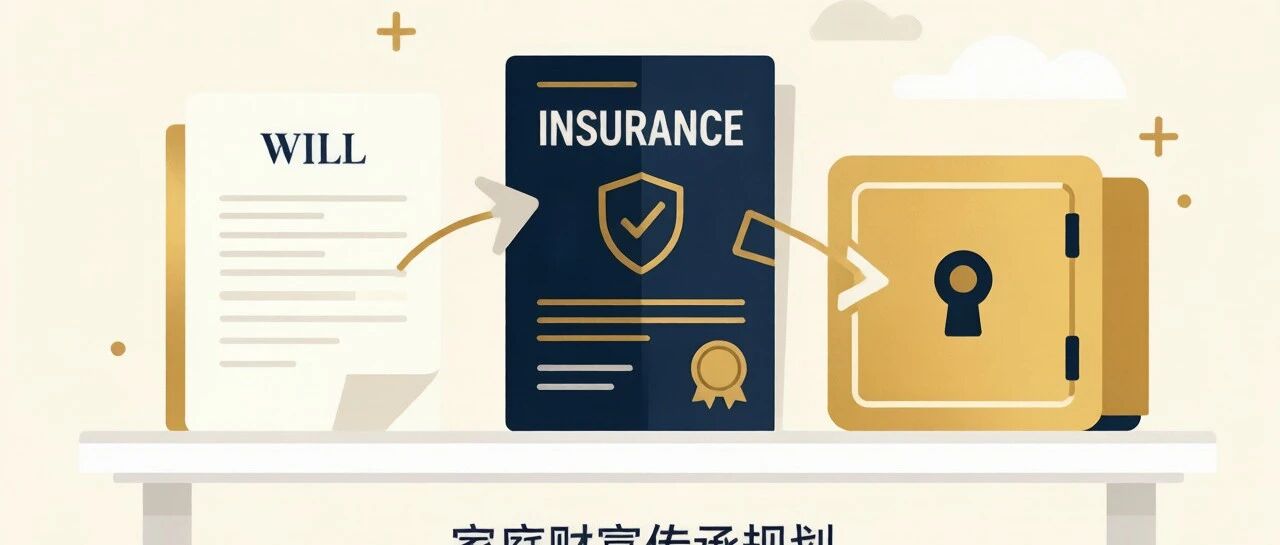
Part 6 (Prevention) | What Will and What Insurance Should a Founding Shareholder’s Equity Be Paired With? Three Wealth Transfer Tools for Family Succession
This article addresses the core question of family wealth management — whether to use a will, insurance, or a trust for equity succession. Drawing on the doctrine of testamentary freedom and its limits under the Succession Book of the Civil Code, the benefit-payment rules of the Insurance Law, and the property-independence principle of the Trust Law, it dissects the functional boundaries of the three instruments and how they should be combined.
Bottom line: These are not three alternatives to choose from — they are three complementary functions. (1) A will solves directed succession — who the equity goes to (Article 1133 of the Civil Code) — but is constrained by the compulsory portion rule (Article 1141), must pass through succession proceedings, and provides no debt insulation. (2) Life insurance solves cash payment: proceeds payable to a designated beneficiary do not form part of the estate (the converse inference of Article 42 of the Insurance Law), bypass succession proceedings, and are not applied to discharge the insured’s debts — but insurance transmits cash only, never control. (3) A family trust solves the separation of control from property: trust property is independent of the settlor’s own assets (Articles 15 and 17 of the Trust Law), enabling risk insulation, flexible distribution, and staged release of benefits upon conditions — the most advanced structure available for equity succession. The sound combination is: a will to fix who receives the equity + insurance to supply liquidity + a trust to separate control from beneficial interest at the top of the structure.
I. A Succession Disaster: Every Tool Used Wrong
Mr. Chen spent twenty years building his company from nothing. It was valued at RMB 800 million, and he personally held 55%. His succession plan consisted of a notarised will drawn up ten years earlier leaving “all equity to my elder son,” plus a RMB 5 million life policy taken out for his younger daughter. He considered the arrangement perfectly balanced and dignified.
When Mr. Chen died suddenly of illness, the troubles arrived in quick succession:
- The elder son took the will to register the equity transfer, and the younger daughter sued, arguing the will violated the compulsory portion (she was a minor with no source of income).
- The company carried RMB 230 million in bank loans. The bank claimed repayment out of the estate, and a large part of the equity’s value was consumed by debts.
- The elder son had no managerial ability whatsoever yet acquired 55% of the equity and voting power under the will. The professional management team walked out en masse, and the company’s valuation halved.
- Because the beneficiary designation on the life policy was defective, the proceeds were dragged into the estate dispute — the last straw that broke the family apart.
Mr. Chen’s mistake was not failing to plan. It was that every instrument was used for what it does worst: the will was treated as a universal distribution machine, insurance as compensation for favouritism, and the only instrument capable of separating control from property — the trust — was never used at all.
II. Legal Characterisation: The Functional Essence of the Three Instruments
| Dimension | Testamentary succession | Life insurance | Family trust |
|---|---|---|---|
| Legal nature | Unilateral juristic act (disposition effective on death) | Contract + third-party-beneficiary arrangement | Transfer of property rights + trustee administration and disposition |
| Core function | Directed distribution of estate assets such as equity | Directed payment of cash, outside the estate | Asset insulation + ongoing management + conditional distribution |
| Transmits “control”? | Yes (equity transfers as a whole) | No (cash only) | Yes (voting rights separable from beneficial interest) |
| Debt insulation | No (estate must first discharge debts — Article 1161 of the Civil Code) | Yes (proceeds to a designated beneficiary are not estate assets and do not discharge the insured’s debts) | Yes (trust property is independent, not the settlor’s estate, and in principle not subject to enforcement) |
| Succession proceedings required? | Yes (notarisation / litigation / registration) | No (claim filed directly with the insurer on a death certificate) | No (the trust continues; administrators hand over) |
| Legal constraints | Compulsory portion (Article 1141); disposition of another’s property is void | Beneficiary designation must be proper; moral-hazard review | Trust registration, lawfulness of assets, no prejudice to creditors |
| Principal cost | Low (execution cost) | Medium (premiums) | High (establishment + annual management fees) |
In one sentence: a will governs ownership, insurance governs liquidity, and a trust governs insulation and control.
III. Doctrinal Foundations: Three Bodies of Legal Logic
1. Testamentary freedom and its limits
Party autonomy is the cornerstone of succession law. Article 1133 of the Civil Code grants natural persons ample freedom to dispose of their property by will, and testamentary succession takes priority over intestate succession (Article 1123). But that freedom is not absolute: the compulsory portion rule in Article 1141 requires that a necessary share of the estate be reserved for heirs “who lack the ability to work and have no source of income” — the mandatory projection of family support obligations into succession law. A will may also dispose only of the testator’s own property: where equity constitutes community property of the spouses, one half must first be allocated to the surviving spouse (Article 1153), and any disposition of the spouse’s share is void. A will is freedom in shackles.
2. The “non-estate” character of insurance proceeds
Where a beneficiary is designated on a life policy, the right to claim the proceeds is the beneficiary’s own right and never forms part of the insured’s estate: the designation creates an independent third-party-beneficiary structure, and the claim vests directly in the beneficiary when the insured event occurs. Article 42 of the Insurance Law confirms this from the converse angle — proceeds are treated as estate only in three cases: no beneficiary designated; the beneficiary predeceases the insured with no other beneficiary; or the beneficiary loses or waives the right to benefits. Two functions follow: bypassing succession proceedings (speed) + immunity from the insured’s lifetime debts (insulation).
3. The independence of trust property
Article 15 of the Trust Law establishes that trust property is distinct from the settlor’s other non-settled property. Where the settlor is not the sole beneficiary, the settlor’s death does not terminate the trust and the trust property does not become part of the estate. Article 17 further provides that trust property may not be subjected to enforcement except in the circumstances specified by law. Together these form the two doctrinal pillars of the trust: bankruptcy remoteness (the settlor’s creditors cannot in principle reach trust property) and survival beyond death (the trust operates long-term according to rules the settlor set in advance). Once equity is settled into a trust, the trust deed can assign the exercise of voting rights to the trustee or a protector while distributing dividend income to family members upon conditions. The separation of control from property can be achieved natively, at the level of legal structure, only through a trust.
IV. Legal Basis
- Article 1133, Civil Code: A natural person may, in accordance with this Code, make a will disposing of personal property and may appoint an executor.
- Article 1141, Civil Code: A will shall reserve a necessary portion of the estate for heirs who lack the ability to work and have no source of income.
- Article 1153, Civil Code: Where property is jointly owned by the spouses, unless otherwise agreed, one half shall first be allocated to the surviving spouse upon division of the estate; the remainder constitutes the decedent’s estate.
- Article 1161, Civil Code: Heirs shall discharge the taxes and debts lawfully payable by the decedent up to the actual value of the estate inherited (limited liability inheritance).
- Article 42, Insurance Law: After the death of the insured, the proceeds shall be treated as estate in the following circumstances: (i) no beneficiary is designated… (iii) the beneficiary loses or waives the right to benefits in accordance with law and there is no other beneficiary.
- Article 15, Trust Law: Trust property is distinct from the settlor’s other non-settled property… Where the settlor is not the sole beneficiary, and the settlor dies or is dissolved, revoked or declared bankrupt after the trust is created, the trust continues and the trust property does not become part of the estate or liquidation assets.
- Article 17, Trust Law: Trust property may not be subjected to enforcement except in the following circumstances: (i) a creditor already held a priority right of satisfaction over the property before the trust was created…
- Article 90, Company Law: Upon the death of a natural-person shareholder, the lawful heir may inherit the shareholder’s qualification, unless the articles of association provide otherwise. (An heir designated by will remains subject to the articles — the interface between the instruments.)
V. Adjudication Rules: Five Common Pitfalls
Case 1: The will disposes of the spouse’s share of equity
Where equity registered in the founding shareholder’s sole name is in fact community property acquired during marriage, the spouse’s 50% must first be separated under Article 1153, leaving the will able to dispose of only the testator’s own half. Courts hold the will partially void, and the heir receives “the willed share × 50%” — a fraction of what was expected.
Case 2: No compulsory portion reserved for an heir who lacks ability to work and has no income
The failure to reserve the compulsory portion renders that part void; the court withholds a necessary share from the estate for that heir before executing the will. Note that eligibility for the compulsory portion is strictly limited (dual requirements: lacking ability to work and having no source of income). Adult children in good health cannot as a rule claim it.
Case 3: Proceeds characterised as estate
Classic failures: the beneficiary field filled in as “statutory” or left blank; no update after the designated beneficiary predeceases the insured; no update after divorce removing the former spouse. Once the facts fall within Article 42, the proceeds are administered as estate — meaning succession proceedings first, debts next. The insulating function of insurance depends entirely on how the beneficiary is designated.
Case 4: Creditors pursue trust property
Where a settlor creates a trust in bad faith to move assets while insolvent or on the brink of insolvency, creditors may apply to have it set aside under Article 12 of the Trust Law; Article 17(i) likewise recognises priority rights that existed before the trust was created. Effective insulation presupposes that the trust is created debt-clean — set up the trust first and take on leverage later; the order cannot be reversed.
Case 5: Testamentary succession conflicts with the articles of association
A will leaves equity to the younger son, but the articles provide that “upon a shareholder’s death the equity shall be bought back by the other shareholders at the appraised value.” The prevailing judicial view: the articles, binding erga omnes, prevail over a will whose effect is merely relative — what the heir receives is the buy-back price (a property right), not shareholder status. Wills and articles must be designed together; otherwise the will accomplishes nothing.
VI. Cross-Application of the Company Law: The Combination Must Land in the Articles
1. Interface between will and articles
Whether the heir designated by will actually obtains shareholder status depends on what the articles provide under Article 90 of the Company Law. If the will says “equity to my elder son” while the articles say “registration of an heir requires the consent of over half of the shareholders’ meeting,” the two must be made to mesh.
2. The company-law channel for trust holding
Placing equity into a trust involves transfer (settlor to trustee) and must comply with the outbound transfer rules of Article 84 of the Company Law (notice + the other shareholders’ right of first refusal). Intra-family trust structures should therefore use the “transfer to persons already within the shareholder group” route, or waive the right of first refusal in the articles in advance, so that establishing the trust does not itself trigger a shareholding deadlock.
3. Valuing unpaid equity on succession
Where equity carries a large unpaid subscription balance, succession — whether by will or trust — should be computed under the contribution-liability logic of Article 88: what the heir or trustee takes on is a bundled package of “equity + contribution obligation.” Insurance proceeds can be pre-positioned as the funding source for the paid-in capital — a classic instance of the instruments working together.
4. Separating control from voting power
Even without a trust, a simplified combination of “will directing equity to the capable child + insurance proceeds compensating the others + acting-in-concert arrangements in the articles” can achieve a structure in which one child holds control and all children share the benefits.
VII. Practical Advice: How to Deploy the Combination
1. Inventory the assets and analyse the family structure before choosing instruments
Inventory: whether the equity is community property; whether any portion is unpaid; whether the articles contain succession clauses; whether there are potential compulsory-portion claimants in the family (minor children, elderly dependants without income); whether large liabilities are foreseeable. Choice of instrument is the product of diagnosis, not a badge of status.
2. Wills: make them early, correctly, and update them regularly
Observe the formal requirements strictly for holographic, dictated and printed wills; update promptly after marriage, the birth of a child, or a major change in the corporate structure; appoint an executor and consider keeping a notarised copy. State clearly in the will which company the equity refers to and the subscribed and paid-in status, so that the subject matter is unambiguous.
3. Insurance: designate beneficiaries by full name, ID number and percentage share
Never write “statutory” or “my wife.” Update immediately upon divorce or the death of a beneficiary. Size the cover against “3–5 years of household cash flow + a debt buffer + balancing compensation for the other children.”
4. Trusts: thresholds and timing
Equity family trusts suit founding shareholders with substantial net assets and complex succession needs (multiple children, cross-generational planning, debt-insulation requirements). Timing should be early — settle assets while both the business and personal balance sheet are healthy, so the insulation will withstand challenge. Key drafting points: the class of beneficiaries and conditions of distribution (age, education, marriage, entrepreneurial incentives), the protector mechanism, arrangements for exercising voting rights, and trustee replacement.
5. A ready-to-use three-instrument framework
A will directs “equity to the child with management ability” → the articles are amended in parallel to include succession clauses and a buy-back pricing mechanism → insurance provides cash compensation for the other children → a trust (where feasible) takes part of the equity’s income rights for cross-generational distribution → at the debt level, three buffers operate together: limited liability inheritance (Article 1161) + insurance proceeds + trust insulation. Each instrument does only what it does best.
6. How a business owner should combine the three
- Early stage: will (foundation) + insurance (buffer)
- Growth stage: + shareholders’ agreement / succession clauses in the articles (governance layer)
- Mature stage: + family trust (insulation + long-term arrangements)
- End objective: when the founder is gone, the equity stays orderly, the company survives, and the family is provided for
VIII. Frequently Asked Questions
Q1: If I have a will, do I still need insurance?
Yes. A will settles what is distributed and to whom, but it cannot solve the two central pain points of equity succession: heirs receive no cash (company dividends are limited and the estate must discharge debts first — Article 1161), and succession proceedings take time. Insurance proceeds are paid quickly and are not applied to debts — exactly complementary. Equity transmits “rights”; insurance transmits “money.”
Q2: Does life insurance really escape debts?
Qualified yes. Proceeds payable to a designated beneficiary are the beneficiary’s personal property and are not used to discharge the insured’s lifetime debts — the converse inference from Article 42 of the Insurance Law, widely accepted in practice. But where no beneficiary is designated, the beneficiary is recorded as “statutory,” or cover is taken out on the eve of death to move assets away, the proceeds will be characterised as estate or set aside, and the insulation fails.
Q3: Is a family trust only for billionaires?
The threshold has fallen considerably; RMB-million-level cash trusts exist in the domestic market, as does practice around settling small and mid-sized equity holdings or policies into trusts. The test is not the size of your wealth but the nature of your needs: balancing among multiple children, debt insulation, arranging corporate control, cross-generational distribution. Where needs are simple, the “will + insurance + articles clause” trio is enough.
Q4: Once equity is settled into a trust, is corporate control secure?
A trust solves the legal structure; control still depends on how the structure is designed: who exercises the voting rights inside the trust (trustee or protector); whether the trust holds equity directly or partnership interests; whether the articles restrict the trust’s acquisition of equity. A poorly designed trust hands control to the trustee and introduces a new category of risk.
Q5: What if the will, insurance and trust conflict with each other?
It depends on which pool the asset sits in. Equity already transferred into the trust is no longer estate, and the will has no power to dispose of it (such disposition being void); anything still in the individual’s name is governed by the will. Which is precisely the point: a succession plan must be designed as a whole — single instruments fighting their own separate battles will inevitably collide.





Leave a Reply